What it really costs to import an excavator from China — duty and freight included
You ask what it costs to import an excavator from China, and someone gives you a single number. Hold onto one thing: the price you see in the listing or at a Chinese auction is not what you will pay. It is the starting point. On top of it come sea freight, customs duty, import VAT and the final haul to your site. Let’s take it apart, piece by piece.
The machine price is just the start
Take a concrete case: a used tracked excavator in the 20-22 tonne class, say a SANY SY215 or an XCMG XE215, a few thousand engine hours, in working order. The purchase price in China is one line on the bill — and, against expectation, rarely the biggest one.
Why? Because added to that figure are costs that, on a machine from the far side of the world, easily swell to half the total budget. The buyer who counts only the purchase price almost always gets a nasty surprise at the end.
Sea freight and the road to port
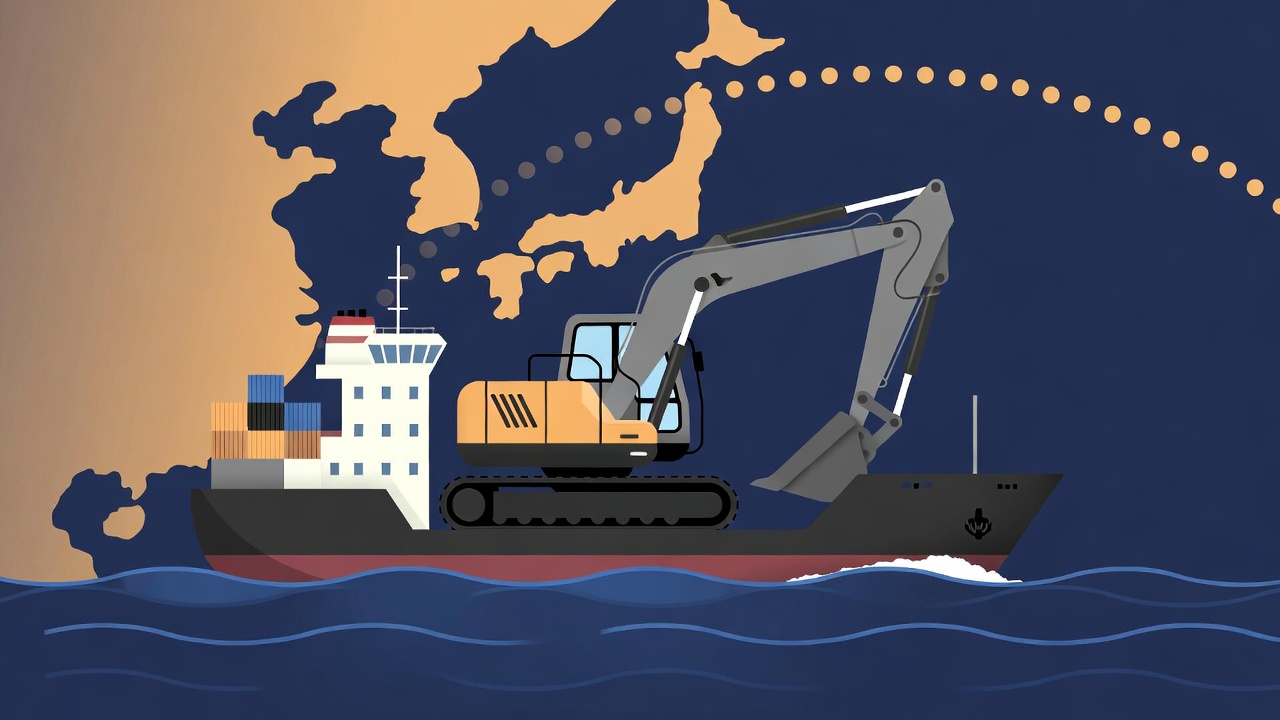
The excavator first travels by truck from the seller’s yard to a Chinese port, then by ship to Europe. A tracked machine over 20 tonnes is an oversize load, so it won’t fit a standard container — it ships RoRo or on a flat rack.
Sea freight rates move around and depend on the route, the season and the exchange rate. Add cargo insurance for the voyage, which on a machine worth hundreds of thousands is not a line to cut.
Duty and VAT — where the bill grows most
This is where amateur importers miscalculate. Construction machinery from outside the EU attracts customs duty, and after that comes import VAT at 23% (on entry to Poland). The catch that matters: VAT is not charged on the machine price alone.
The VAT base is the customs value — the machine price plus freight, insurance and the duty already applied. In other words, you pay tax on tax. That single line lifts the bill harder than the transport itself, and it is exactly why rough mental maths ends in a shock at clearance.
Customs clearance and paperwork
The machine won’t cross the border without a full set of documents. You need the purchase invoice, the transport document, a declaration of conformity and the correct tariff classification — the right CN code. Get the code wrong and you either overpay duty or have the cargo held for review.
Then there’s the customs agency, any translations and port charges. Each item alone is small. Together they are another few thousand that’s easy to forget until you’re standing in front of the customs office.
The last leg: from port to your site
The excavator sits in a port in Gdańsk or Hamburg, and your site is near Rzeszów. That last leg means low-loader transport on a low-bed trailer, because a tracked machine isn’t driving itself across half of Poland.
For an oversize load you add a transit permit, sometimes an escort vehicle, and on heavier machines route planning under bridges and overpasses. This is not “throwing the machine on a trailer” — it’s a separate logistics job with its own cost.
What it all adds up to
Sum it: machine price, sea freight, insurance, duty, import VAT, clearance, domestic transport. Only that total is the real cost of importing an excavator from China. The auction figure we started with is often barely half the final bill.
That’s why Prosta Wola gives you one turnkey number — machine, transport, insurance and duty costed in a single figure, with no extras surfacing at the port. You know what you’ll pay before anything sets sail. Want a worked example of the cost of importing an excavator from China for your model? We source used machinery to order from Rzeszów, Poland — get in touch or call +48 724 238 175. See what we can source to order in our catalogue.