What to check on a used excavator: engine hours, undercarriage, hydraulics
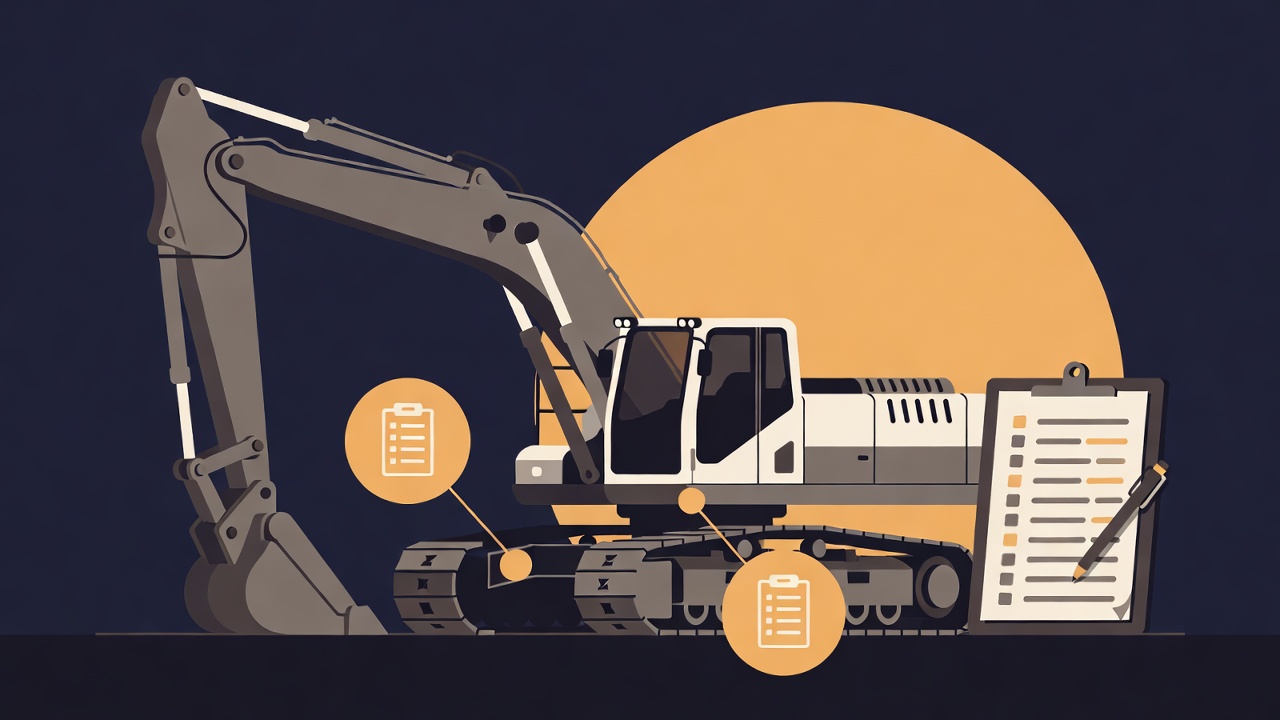
You’re wondering how to check a used excavator so you don’t buy someone else’s problem. Good news: most serious faults are visible if you know where to look. Bad news: the seller will show you what shines, not what costs. Here’s what we look at before a machine goes into our offer.
Engine hours and what they really mean
The hour meter is the first number everyone looks at. Except the meter alone says little — an excavator with 8,000 hours serviced to the letter can be better than a unit with 4,000 hours run into the ground.
Take a 20-tonne tracked excavator as an example: what matters is how those hours were run. Continuous work on a single site wears a machine differently from constant transport and cold starts. Ask about the history, not just the meter.
The undercarriage — the priciest item on the list
On a tracked machine the undercarriage is the part that can eat a repair budget. Check the tracks, the track rollers, the idlers and the drive sprockets. A worn undercarriage is no trifle — replacing the full set on a 20-tonne machine runs into tens of thousands of złoty.
Look at the evenness of the wear. If one side is clearly more worn, the machine may have worked on slopes or had a drive problem. That’s a question to ask before the purchase.
Hydraulics: leaks and reaction time
The hydraulics are the heart of an excavator. Walk around the machine and look for leaks on the cylinders, hoses and the control valve. A wet cylinder rod is a sign the seals are going.
Then start the machine and work through every function. Boom, bucket, slew — the movements should be smooth and sure. Jerking, the boom dropping under load or a slow response is a symptom of a worn pump or valve. That’s a repair you don’t want to discover after buying.
Engine, cooling system and electronics
Start the machine cold and listen. A hard start, blue or white smoke, knocking — each of these symptoms needs explaining. Check the level and colour of the oil and coolant; emulsion in the oil is a warning sign.
On newer machines there’s the electronics and the exhaust after-treatment system. Errors on the display, a disabled DPF or software “workarounds” are risks that on an import have to be verified on the spot, not from photos.
Documents and provenance
A machine without papers is a machine at half its value. Check the serial number on the frame and compare it with the documents. Establish the country of origin and the ownership history if you can. On an import, the completeness of the documentation for customs clearance and later resale matters too.
Our rule is simple: we inspect the machine physically at source before anyone sends a deposit. A checklist is one thing, but you have to lay a hand on the hydraulics in the flesh.
And then you get one turnkey price from Prosta Wola — the checked excavator, transport and duty in a single figure, with no surprises along the way. Want us to inspect a specific used excavator against your requirements? We import used construction equipment to order from Rzeszów, Poland — get in touch or call +48 724 238 175. For inspiration, browse the catalogue.